.png)
From Patchy Data to Strategic Alignment: Why IT Services Leaders Need a Better Scorecard
- Abu Moniruzzaman
- Sep 15, 2025
- 3 min read
If you're leading an IT services or consulting firm, your daily life revolves around balancing active projects, shifting client demands, resource bottlenecks, and delivery escalations. You’re overseeing technical execution but also managing relationships, defending margins, and navigating hybrid methodologies. And all of this happens under intense pressure to deliver outcomes, not just effort.
What makes it harder? You can't see the whole picture. Work is happening. Teams are busy. Tools are humming. But when it comes time to show what’s actually been achieved, you’re left stitching together dashboards, timelines, and estimates that rarely tell a cohesive story.
That’s not just frustrating. It’s risky.
Disconnected tools can’t deliver connected outcomes
In most IT services companies, work is scattered across project management tools, spreadsheets, communication apps, and siloed dashboards. Waterfall projects live in Gantt charts. Agile teams sprint in Jira. Client work is tracked separately from internal initiatives. And OKRs—if they exist—sit in a static slide deck reviewed once a quarter.
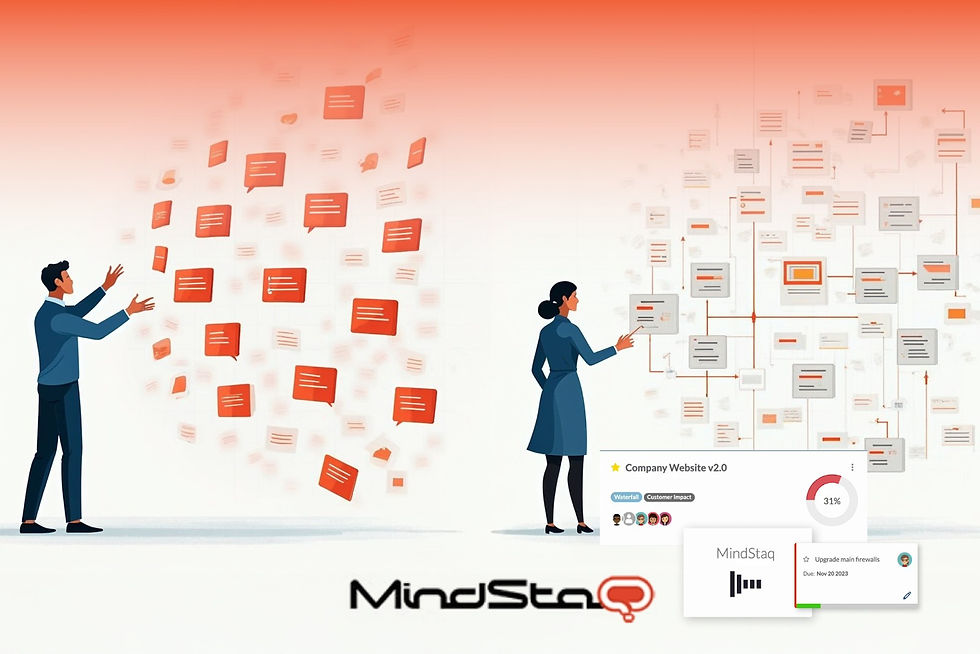
What results is what we call “program fog.” The execution data exists, but it’s fragmented. There’s no shared visibility. No way to trace execution to outcomes. And no mechanism for identifying when you're falling behind—until the client escalates or the quarter ends.
According to McKinsey, 70% of digital transformation projects fail due to poor visibility and alignment.
In an IT services context, that shows up as:
Burned-out teams chasing shifting priorities
Escalations from clients when no one saw the risk early
Inability to defend resource allocations
Work getting done, but value not getting delivered
Scorecards create cohesion in the middle of operational noise
Unlike static dashboards or slide-deck status reports, scorecards are living systems. They connect business objectives to delivery work in real time.
Through a structure built around OKRs (Objectives and Key Results), a scorecard allows you to define outcomes at the program level, break them down into measurable results, and then link those results directly to deliverables, teams, and timelines.
This gives your teams clarity on what matters most. It gives your leadership a reliable signal on what’s moving and what’s blocked—without asking people to switch tools or update five places at once.
Hybrid methodology? No problem. Scorecards sit above the chaos
Many firms attempt to “standardize” methodology across teams, only to face resistance. Different teams use different methods for a reason. Dev prefers agile. Infra needs waterfall. Nobody wins when you force a uniform approach. Scorecards don’t ask teams to change how they work. They tie together what they’re already doing.
At the program level, you gain a single view that reflects everything, regardless of delivery method.
Agile and waterfall projects feed into shared key results
Dependencies are tracked across methods and teams
Business leaders get clear visibility into progress without needing to interpret backlogs
Agile sprints, Gantt-based timelines, and cross-functional dependencies. All can coexist in a scorecard that keeps results at the center.
Coherence shouldn’t require duct tape
MindStaq’s scorecard capability is built for the messy, multi-layered, cross-functional reality of modern IT delivery. It offers unified visibility, linking OKRs, projects, timelines, and team charters into one intelligent view. It doesn’t replace your methodology. It respects it. But it adds structure where your current tools add noise.
If your leadership meetings still begin with, “So what exactly are we getting done?”, you already know something's broken.
MindStaq offers a way to fix it systematically, visibly, and without changing how your teams work. Just how they connect.
A scorecard isn’t a report. It’s an internal GPS for delivery. Get yours for free today!


